A recent road reconstruction on Heretaunga Street East exposed the silty streambed deposits typical of the Heretaunga Plains. The contractor was chasing a tight N grade for the subbase course, but the borrow source kept bleeding fines from a volcanic ash lens. We ran a combined sieve and hydrometer series right on the timeline they needed. Hastings sits on alluvial gravels, pumice sands, and loess-derived silts that shift gradation within a single cut. A standard dry sieve won't catch the silt and clay fraction, and leaving that fraction unmeasured leads to pavement rutting or filter clogging. Our laboratory runs the full particle size distribution from 75 mm cobbles down to the 2-micron clay range using the NZS 4402 methods. For pavement jobs, we often pair grain size analysis with the CBR test for roads to link gradation directly to bearing performance, and for structural fill we cross-check with sand cone density to confirm compaction on the same material.
If the D15 of the filter isn't four to five times the D15 of the base soil, the drain will clog—and Hastings silts make that ratio unforgiving.
Technical details of the service in Hastings
Risks and considerations in Hastings
Between the Havelock North hills and the low terraces near Clive, the gradation profile changes from residual sandy silts to well-graded river gravels in less than two kilometres. A bridge approach designed for the gravels but built on the silts will pump fines into the structural backfill with the first wet winter. The open-graded drainage aggregate specified for the abutment can become a silt trap instead of a drain if the particle size curves of the filter and the surrounding formation do not meet the retention ratio. The 2023 cyclone demonstrated how fast fine-grained layers lose strength when pore pressure builds. Without a hydrometer curve, the fines content stays invisible, and the drainage design is guesswork. On subdivisions above old orchards, the topsoil contains decomposed organic grit that skews the uniformity coefficient; a sieve-only report misses it entirely. The Heretaunga aquifer also imposes strict filter criteria for any bored pile or well installation, and the regional council expects gradation logs as part of the consent package.
Our services
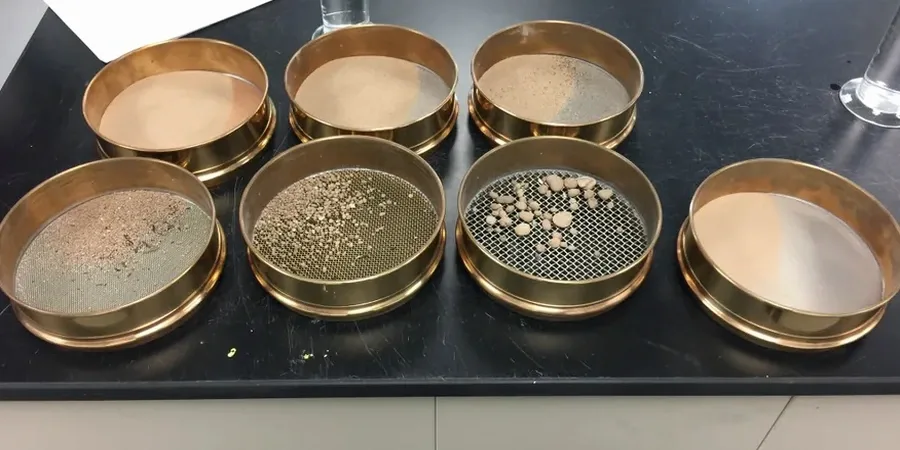
Our Hastings laboratory runs the full particle size suite under one IANZ-accredited quality system. Turnaround is typically three working days for a standard sieve-plus-hydrometer set, with express options during earthworks peaks.
Combined Sieve & Hydrometer (full curve)
From 75 mm cobbles to 2-micron clay. Includes oven moisture, wash-through mass, hydrometer sedimentation readings, and a plotted semi-log gradation chart with Cu/Cc.
Wash Sieve Check for Fill Compliance
Focused on the minus-75-micron fraction. Rapid turnaround for borrow pit approval and trench backfill verification against NZS 4402 specification limits.
Filter Compatibility Package
Gradation analysis on both the base soil and the filter aggregate plus a Terzaghi retention ratio report. Used for retaining wall drains, chimney filters, and monitoring well packs.
Questions and answers
What does a grain size analysis cost in Hastings?
A combined sieve and hydrometer run typically ranges from NZ$200 to NZ$320 per sample, depending on whether it's a full curve from 75 mm or a shorter wash-sieve check. The price includes oven drying, riffle splitting, the mechanical shaker series, the sedimentation cylinder readings, and the plotted report with Cu/Cc. Bulk rates apply for five or more samples from the same project.
Why do I need the hydrometer if the material looks clean?
Many Hastings silts and volcanic ash layers pass a 75-micron sieve but still carry 8–15% clay-sized particles that govern plasticity and permeability. The hydrometer separates the silt from the true clay fraction. Without that split, you cannot calculate the clay activity or apply Terzaghi filter criteria correctly.
How much sample do you need for a full gradation test?
For material with a maximum particle size up to 20 mm we need about 1 kg after splitting. If cobbles larger than 37.5 mm are present, the required field sample jumps to 10–30 kg so we can riffle down a representative portion. We can supply sample bags and guidance for site sampling.
Can you match the NZGS soil description to the gradation curve?
Yes. Every report includes the NZGS soil group symbol and description—for example, 'sandy SILT with some gravel, fine to medium plasticity'—based on the particle size distribution, plasticity index if we run Atterberg limits on the same sample, and visual-log correlation.