When the Hawke’s Bay Regional Council tightened its consenting requirements following the 2016 Kaikōura earthquake sequence, the engineering community in Hastings saw a fundamental shift in how retaining structures are evaluated. NZS 3404:1997 and the Geotechnical Society’s modular wall guidelines now demand a level of site-specific soil-structure interaction analysis that goes well beyond a simple bearing check. Our approach starts with the premise that every retaining wall design in this city must account for the Heretaunga Plains’ layered alluvial profile—dense gravels interbedded with compressible silts—because what fails is rarely the wall itself but the ground it sits in. That is why we embed the cone penetration test early in the design workflow, using continuous tip resistance and pore pressure data to map the exact depth where gravel transitions to silt, so the wall stem and heel are dimensioned for the real stratigraphy, not a textbook assumption. It is a method shaped as much by local geology as by code compliance.
Retaining wall failure in Hastings is almost never a concrete problem—it is a pore pressure problem that nobody measured before excavation.
Technical details of the service in Hastings
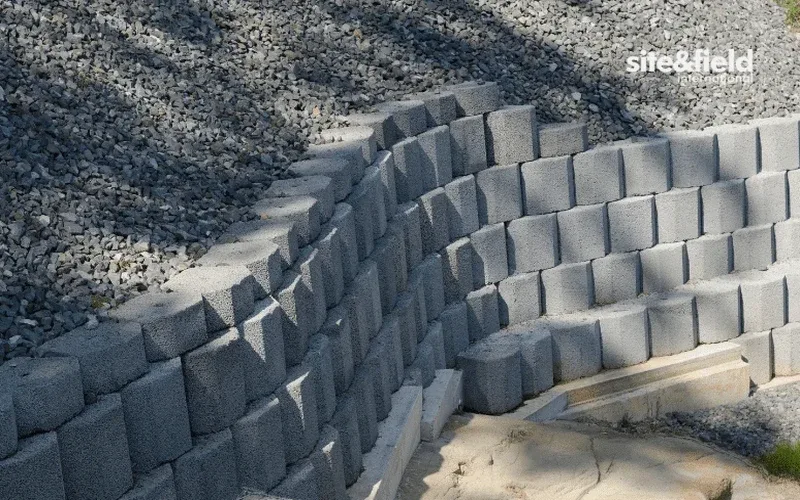
Risks and considerations in Hastings
A 25-tonne excavator fitted with a tilt-rotator bucket opens up the wall alignment trench just south of Havelock North, exposing a profile that the CPT logs predicted: 1.8 metres of silty gravel over a thick dark clay that glistens when the bucket teeth slice through it. That clay is the reason we bring a hand shear vane to every wall excavation in Hastings. Its undrained shear strength can drop below 25 kPa when saturated, which means the passive wedge in front of the wall base cannot develop the resistance assumed in a standard Coulomb analysis. If the design relied on textbook passive coefficients without a site-specific reduction factor, the wall rotates forward slowly over the first rainy season—and by the time the crack opens at the top, the base has already moved 40 millimetres. We specify a deeper key and a widened base in these profiles, and we replace the bottom metre of backfill with a structural gravel wedge that shifts the thrust vector downward. These are adjustments that no desktop study can anticipate without the physical confirmation that the excavator and the shear vane provide together.
Our services
Retaining wall design in Hastings spans a range of scales, from modest garden terracing in Parkvale to multi-level basement retention for commercial builds along Heretaunga Street. The workflow adapts to the height, loading, and consequence class of the structure, but the underlying principle does not change: the wall geometry emerges from the ground investigation, not the architect’s section. Below are the service modules we deliver, each calibrated to the geological conditions of the Heretaunga Plains.
Residential Cantilever & Gravity Walls
For cuts up to 3.0 metres in residential zones, we design reinforced concrete or crib walls with full geotechnical justification. Includes bearing capacity verification on the specific alluvial stratum, backfill specification, and drainage detailing to prevent hydrostatic buildup behind the stem.
Commercial Basement Retention Systems
Multi-level excavations in the Hastings CBD require anchored or strutted wall systems. We provide the geotechnical design brief for secant pile or soldier pile walls, including lateral earth pressure distributions, anchor bond length calculations, and staged excavation sequencing.
Hillside & Rural Retaining Structures
Slopes along the Te Mata Peak foothills and lifestyle blocks demand walls that handle both static and seismic loading on inclined ground. We combine slope stability analysis with wall design to ensure global stability of the soil-wall system, not just the structural element in isolation.
Design Audit & Peer Review
For walls designed by others or as part of a consent condition, we conduct independent geotechnical design reviews against NZGS guidelines. The review traces every parameter back to a site investigation finding and flags any unconservative assumptions before construction begins.
Questions and answers
How much does a retaining wall design cost in Hastings?
Retaining wall design fees in Hastings typically range from NZ$1,690 to NZ$7,400, depending on wall height, complexity, and the amount of site investigation data already available. A straightforward cantilever wall under 2.0 metres with existing soil test information sits at the lower end, while a commercial anchored wall system requiring additional CPT or borehole data and seismic analysis will move toward the upper end of that range. We provide a fixed-fee proposal after reviewing the site plan and any existing geotechnical reports.
Do I need a building consent for a retaining wall in Hastings?
Under the Hawke’s Bay Regional Council rules, retaining walls exceeding 1.5 metres in height generally require a building consent, and walls that support a surcharge from a building or driveway may require consent regardless of height. Walls under 1.5 metres that are not part of a building’s structural support system may be exempt, but we still recommend a geotechnical check because the alluvial soils in Hastings can settle differentially and cause even low walls to tilt. We advise on consent requirements during the initial site assessment.
What is the biggest cause of retaining wall failure in the Heretaunga Plains?
The dominant failure mechanism we observe in Hastings is inadequate drainage behind the wall. The silty layers within the alluvial profile trap water, and without a properly designed and installed continuous strip drain, hydrostatic pressure builds up behind the stem during wet winters. This pressure adds a lateral load that the wall was not designed for, and the base either slides forward or the wall rotates. We specify free-draining backfill, filter fabric, and weep holes at regular intervals on every design, and we recommend the drain be inspected after the first heavy rainfall before the contractor demobilises.
How long does the design process take from site visit to issued drawings?
A typical residential retaining wall design in Hastings takes between 10 and 15 working days from the site investigation to the delivery of signed construction drawings. The timeline depends on whether we need to commission additional CPT or laboratory testing—if the site already has a recent geotechnical report, the process is faster. Commercial wall designs with multiple retention levels and anchor systems generally require 20 to 25 working days because of the additional analysis and peer review steps that NZGS guidelines recommend for higher-consequence walls.