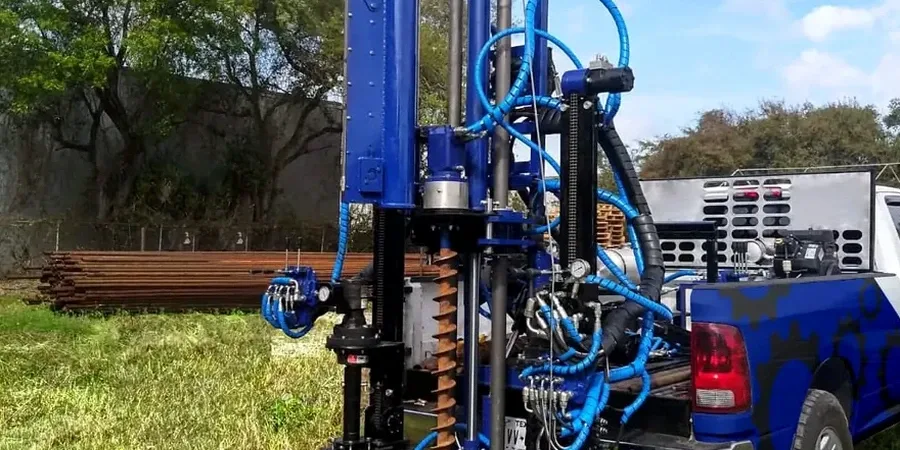
On Hastings sites, we often see that relying on just a borehole log without dynamic penetration data leaves too many unknowns when you hit the layered gravels and silts of the Heretaunga Plains. The Standard Penetration Test delivers the N-value sequence that council engineers and geotechnical reviewers actually want to see. Our team runs a calibrated SPT hammer on a track-mounted rig, recording blows every 150 mm and pulling disturbed samples for logging. For deeper liquefaction assessment you sometimes need a complementary CPT profile, and on commercial pads we often combine the SPT with a plate load test to confirm stiffness directly under the footing zone. Every SPT we produce is referenced to NZS 3404 and the NZGS guidelines on soil description, and we include the raw field sheets in the final report so there is no ambiguity about refusal depths or seating drive corrections.
In Hastings gravelly-sand profiles, the standard SPT N-value often needs overburden correction before you can trust it for foundation design — raw N alone misleads more often than it helps.
Technical details of the service in Hastings
- 60-degree cone tip on standard split-spoon sampler per NZGS field guide
- Blow counts recorded at 0-150, 150-300 and 300-450 mm penetration intervals
- Disturbed sample bagged, logged and stored for index testing if required
- Groundwater strike noted during drilling and confirmed at completion
- N1(60) correction applied for overburden stress in liquefaction assessments
Demonstration video
Risks and considerations in Hastings
A five-storey mixed-use project on Karamu Road hit refusal at 4 metres in what the driller assumed was ‘good gravel’, but the SPT N-value was 45 over 250 mm penetration and the sampler shoe was bent — that is not bearing stratum, that is a thin bouldery lens over compressible silt. We have seen similar profiles near the Hawke's Bay Opera House precinct and along St Aubyn Street, where the gravel cap is patchy and the underlying silty sand records N-values below 8. Basing a raft or isolated footings on that refusal depth without deeper verification risks differential settlement exceeding 25 mm under service load, which triggers NZS 3604 performance issues for masonry and cladding. The SPT log with depth-continuous N-values exposes the weak layer before the concrete is poured. In liquefaction-prone zones mapped in the Hastings District Council hazard register, corrected N1(60) below 15 at depths less than 10 metres demands ground improvement or deep foundations — an SPT-only investigation without that correction is non-compliant for building consent.
Our services
Beyond the SPT itself, we provide the supporting field and lab services that Hastings projects typically require to close out the geotechnical brief. Each service is executed under the same NZS 3404 and NZGS framework so the data chain stays coherent from borehole to foundation recommendation.
SPT with disturbed sampling and logging
Full SPT run with split-spoon sample recovery, field logging by an NZGS-trained engineering geologist, and N-value correction for overburden and hammer energy.
Combined SPT-CPTu liquefaction screening
Paired SPT and CPTu soundings at the same coordinate to cross-calibrate N1(60) and qc1Ncs for consent-grade liquefaction assessment on the Heretaunga Plains.
Foundation bearing capacity report
Derivation of ultimate and allowable bearing pressure from SPT N-values, correlated with NZS 3604 good-ground criteria and supplemented by lab index testing where silts are present.
Questions and answers
What does an SPT test cost for a standard residential section in Hastings?
For a typical single-borehole SPT programme on a residential lot, the cost ranges from NZ$960 to NZ$1,220 depending on depth, access and whether you need the full disturbed-sample logging suite. Deeper commercial investigations with multiple SPTs and companion CPT soundings are quoted per metre after we review the site plan and the council consent requirements.
How deep do you need to drill for an SPT on a Hastings building site?
For single-storey residential on the plains we usually target 8 to 12 metres, which is enough to penetrate the gravel cap, capture the silt layer if present, and reach competent bearing material. Multi-storey or light commercial jobs on softer ground often extend to 15–20 metres so we can characterise the full liquefiable sequence down to the non-liquefiable stratum.
Can the SPT N-value be used directly for liquefaction assessment, or do you need a CPT as well?
SPT N-values can be used for liquefaction triggering analysis once they are corrected to N1(60), but the Hastings District Council and peer reviewers increasingly prefer a paired SPT-CPT approach. The CPT provides a continuous profile with higher vertical resolution, while the SPT gives you a physical sample for fines content — combining both gives the most defensible liquefaction assessment under the NZGS-MBIE Module 4 framework.