The most frequent mistake we see in Hastings tunnel projects is treating the Heretaunga Plains alluvium like a uniform mass. It isn't. A crew hits a buried paleochannel of saturated fine silt under a residential subdivision, and the face extrusion doubles overnight. That's the moment the TBM guidance parameters stop matching the borehole log from three weeks earlier. We start the geotechnical analysis for soft soil tunnels by mapping the depositional history—the old Ngaruroro River courses that left lenses of compressible clay within the gravels. Standard NZS 3404 Part 4 parameters aren't enough when the material transitions from SP-SM to MH over a two-metre advance. Before mobilising the roadheader, we run a full suite of triaxial consolidated-undrained tests and correlate them with CPT pore pressure dissipation data to define the undrained shear strength profile along the alignment.
In saturated Hawke's Bay alluvium, the undrained shear strength can drop 40 percent within a single TBM shift if the pore pressure regime isn't mapped ahead of the face.
Technical details of the service in Hastings
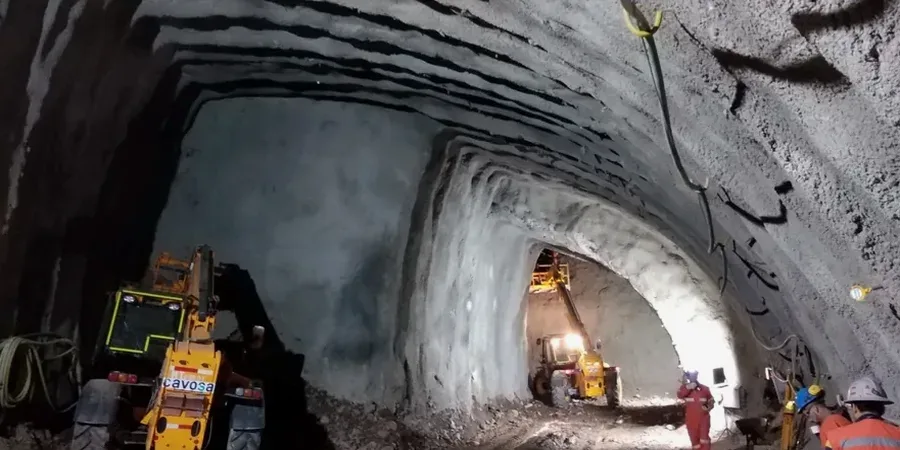
Risks and considerations in Hastings
NZS 3404:1997 explicitly requires a geotechnical investigation report for any excavation exceeding 1.5 metres depth in variable ground—and in Hastings, 'variable' is the default condition. The Heretaunga Plains conceal abandoned river channels packed with normally consolidated silts that can transition into a flowing condition under minimal disturbance. If the pre-construction analysis misses a five-metre-wide lens of liquefiable material at tunnel invert level, the consequence isn't just settlement; it's a sudden loss of face stability that no forepoling system can recover. We've seen the data from post-earthquake investigations: the 1931 Hawke's Bay quake remoulded these silts across the entire plains, and the sensitivity of the deposits hasn't diminished with ninety years of consolidation. A rigorous liquefaction screening using NZGS-MBIE guidelines, combined with site-specific cyclic triaxial testing, is the minimum we require before any tunnel boring machine enters the ground in this region.
Our services
Our Hastings-based geotechnical analysis programme for soft ground tunnels is structured around the NZGS guideline framework and the specific depositional environment of the Heretaunga Plains. Every testing schedule we design starts with the question: what did the Ngaruroro River do here two thousand years ago?
Pre-Tender Site Characterisation
Desk study integrating LINZ aerial archives with targeted CPTu soundings and borehole sampling. We map paleochannel boundaries and provide an interpretative geotechnical model with cross-sections at 20-metre intervals along the alignment.
Advanced Laboratory Programme
CIU and CAU triaxial series at in-situ effective stress, oedometer tests with incremental loading to 3.2 MPa, and resonant column tests for small-strain stiffness. All testing under ISO 17025 quality management, with NZS 4402 procedural compliance.
TBM Parameter Design Support
Face pressure and backfill grouting pressure envelopes derived from the undrained strength profile and the groundwater regime. We provide real-time parameter adjustment criteria for EPB or slurry shields based on the extrusion rate and cutterhead torque signatures.
Questions and answers
What does geotechnical analysis for soft soil tunnels in Hastings typically cost?
The range depends on alignment length and laboratory scope, but typically falls between NZ$7,270 and NZ$26,120. A short pedestrian tunnel under a single road crossing sits at the lower end with a focused CPT and triaxial programme. A multi-kilometre pipeline alignment across the Heretaunga Plains, requiring continuous sampling, cyclic testing, and detailed paleochannel mapping, runs toward the upper figure.
Which NZGS guidelines apply to soft ground tunnelling in the Hawke's Bay region?
The NZGS-MBIE Earthquake Geotechnical Engineering Practice modules are fundamental, particularly Module 4 on liquefaction assessment. For the tunnelling methodology, we reference the NZGS guidelines on soil description and classification, along with NZS 3404 Part 4 for temporary works in soft ground. The site investigation data is processed following NZS 4402 methods for all laboratory testing.
How do you manage the risk of face instability in the Heretaunga Plains silts?
We map the undrained shear strength profile with CPTu soundings at no more than 10-metre spacing along the alignment, cross-referenced with borehole samples for Atterberg limits and moisture content. Where the liquidity index exceeds 1.2, we specify continuous face support pressure monitoring and define an upper extrusion rate threshold of 0.8 mm per minute. Pre-treatment with dewatering or ground improvement is evaluated based on the consolidation coefficient from oedometer data.