Hastings, sitting on the Heretaunga Plains with over 51,000 residents, faces a specific geotechnical challenge: the alluvial gravels and interbedded silts deposited by the Ngaruroro and Tukituki rivers can vary from dense to dangerously loose within a single site footprint. When the 1931 Hawke's Bay earthquake raised the coastal plain by more than two metres, it was a brutal reminder of the tectonic energy running beneath this city. Today, any major structure in Hastings—from industrial coolstores near Whakatu to new subdivisions in Lyndhurst—demands a foundation soil that will not densify unpredictably under seismic load. Our vibrocompaction design service addresses this directly, using depth vibrators to homogenise the granular matrix and build a stiff, engineered platform that meets the performance criteria of NZS 3404. Before mobilising to a Hastings site, we often correlate the soil profile with CPT test data to map the zones requiring the most aggressive treatment and confirm that the fines content won't inhibit the compaction process.
A well-designed vibrocompaction grid in Hastings gravels can lift relative density from 40% to over 75%, eliminating the settlement risk that static rollers simply cannot reach.
Technical details of the service in Hastings
Risks and considerations in Hastings
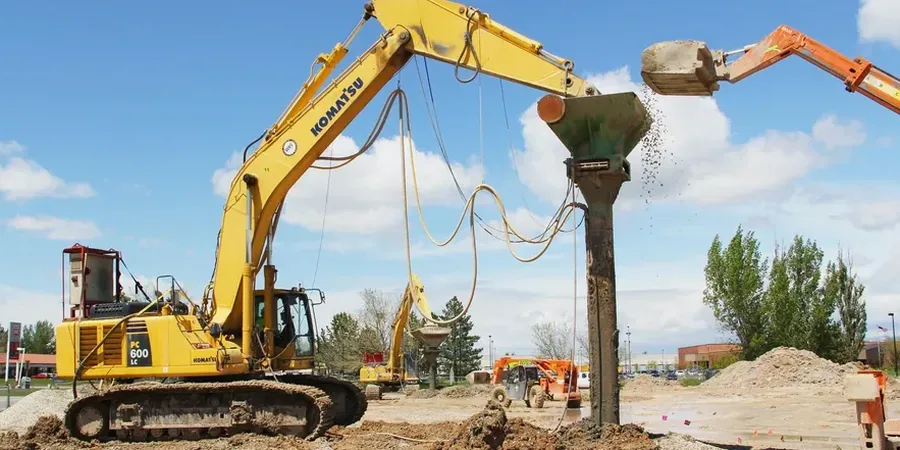
The vibrocompaction rig is a sizeable piece of equipment—a crawler-mounted leader with a 3.5-tonne depth vibrator hanging from a high-tensile steel cable, often equipped with an onboard data acquisition system that plots amperage and depth in real time. On a Hastings site underlain by loose alluvium, the primary risk isn't machine failure; it's the undetected presence of cohesive silt lenses that can absorb vibratory energy without densifying, creating treated zones with stubbornly low stiffness. If these pockets are missed during the design phase, the final platform can exhibit differential settlement under the cyclic racking of a seismic event, defeating the purpose of the improvement. We mitigate this by running a dense grid of SPT drilling before the vibro work begins, mapping the stratigraphy in enough detail to either exclude silty zones from the treatment volume or switch to a complementary technique like stone columns in those isolated patches.
Our services
Our Hastings vibrocompaction packages combine field execution with a design backbone that keeps the contractor and the structural engineer aligned from the first probe to the final acceptance sign-off.
Design & Specification Package
We produce a site-specific vibrocompaction design report for your Hastings project, defining the vibrator type, grid geometry, target depth, flushing medium, and acceptance criteria tied to post-treatment CPT or SPT values. The package includes a QA/QC plan aligned with NZGS guidelines and a settlement performance forecast.
Field Supervision & Verification Testing
Our team oversees the vibrocompaction operation on your Hawke's Bay site, monitoring real-time vibrator logs and executing the verification testing campaign—pre- and post-treatment CPTu soundings with pore pressure dissipation—to confirm that every treated zone meets the specified relative density before handover.
Questions and answers
What is the typical budget range for vibrocompaction design and supervision on a Hastings residential or commercial site?
For a standard Hastings site requiring design, specification, and field verification, the professional fee typically falls between NZ$2,790 and NZ$8,880. The spread depends on the treatment depth, the complexity of the soil profile (interbedded gravels and silts), and the number of verification CPT soundings needed to satisfy the QA/QC plan.
How does the high groundwater table in parts of Hastings influence the vibrocompaction process?
A shallow water table, common across the Heretaunga Plains, actually works in favour of vibrocompaction. The water reduces the effective stress between grains, allowing the vibratory energy to rearrange particles more efficiently. We typically use water flushing rather than air in these saturated conditions, and we monitor pore pressure dissipation during the verification CPT to confirm the treatment has reached the target density.
Can vibrocompaction be used if the Hastings soil has more than 15% silt content?
Vibrocompaction loses efficiency when the fines content (passing 0.075 mm) exceeds about 15%, because the silt dampens the vibratory transmission between the larger grains. On Hastings sites where the alluvial deposits contain significant silt layers, we either exclude those zones from the vibro treatment plan or recommend a switch to stone columns or dynamic replacement in those specific horizons. The decision comes down to the grain size curve and Atterberg limits, which we always run before finalising the design.