The most expensive mistake we see in Hastings foundations is guessing the pile length. A three-metre pile in Heretaunga Plains alluvium that stops short of competent gravel will settle under load, and retrofitting deep foundations under an existing structure costs five times more than getting the design right the first time. Pile foundation design here is not a catalogue exercise; it requires site-specific geotechnical parameters tied to CPT refusal depth, groundwater monitoring data, and the seismic demand from NZS 1170.5. We deliver pile designs that reconcile the structural loads with the actual stratigraphy encountered. When the upper silts lack end-bearing capacity, we often combine deep piles with a ground improvement strategy to control total and differential settlement, and we rely on CPT data for continuous profiling where SPT blow counts are too coarse to catch thin liquefiable layers.
A pile group in Hastings is only as reliable as the liquefaction assessment behind it — lose the upper 12 metres and the entire load path changes.
Technical details of the service in Hastings
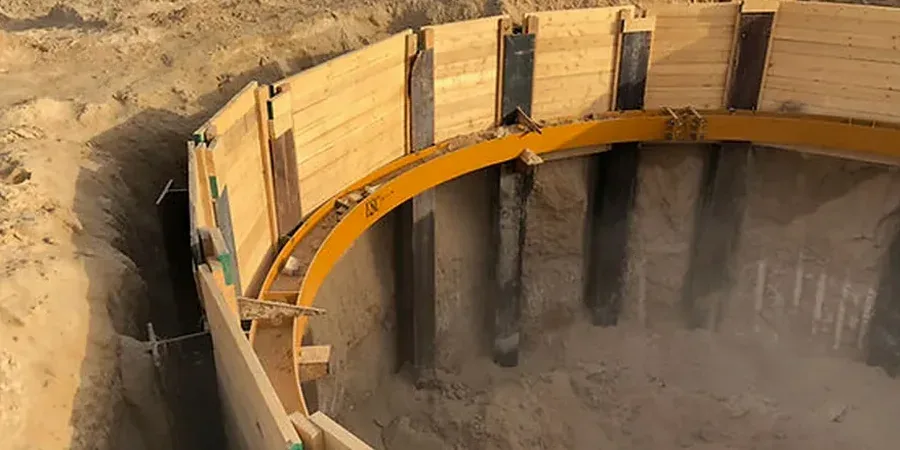
Risks and considerations in Hastings
NZS 1170.5 and the MBIE guidance on liquefaction-prone ground make deep foundation verification non-negotiable for Importance Level 2 structures and above in much of Hastings. The risk is not theoretical: the 1931 Hawke's Bay earthquake produced widespread lateral spreading on the Plains, and modern CPT-based assessments show that large portions of the city remain vulnerable. A pile design that ignores kinematic loading from lateral spread will underestimate bending moments at the liquefied/non-liquefied interface by 40% or more. We run t-z and p-y analyses with reduced soil springs in the liquefied zone to capture this effect. The consequence of under-design is a pile group that survives axial load but fails in flexure, cracking the pile cap and damaging the superstructure. The cost of this verification — a few thousand dollars in analysis — is negligible against the structural replacement cost it prevents.
Our services
Our Hastings pile foundation scope covers the full design chain, from parameter derivation to construction-phase testing.
Axial Capacity Design
Static analysis using CPT-based methods (LCPC, UniCone) and SPT correlations, calibrated to local gravel bearing strata. Settlement prediction via t-z curves and group efficiency factors from Poulos & Davis.
Lateral and Seismic Pile Analysis
Lateral load response modelled with LPILE or equivalent p-y software, incorporating liquefied soil strength reduction and kinematic spreading demands per NZGS guidelines.
Pile Driving and Testing Specification
Wave equation analysis for drivability, PDA dynamic test acceptance criteria, and static load test procedures aligned with NZS 4402 and international practice.
Questions and answers
How much does a pile foundation design package cost in Hastings?
A full design package — including geotechnical parameter derivation, axial and lateral pile analysis, liquefaction assessment, and construction specifications — ranges from NZ$2,480 for a straightforward residential pile group to NZ$11,850 for a commercial structure requiring dynamic testing supervision and peer review. The fee depends on the number of boreholes or CPTs to interpret and the structural complexity.
What pile types work best in Heretaunga Plains soils?
Driven precast concrete piles dominate residential and mid-rise work because they penetrate the interbedded silts efficiently and achieve set on the deep gravels. Continuous flight auger piles suit sites with vibration restrictions. Steel H-piles are specified where high lateral demands or deep liquefaction require ductile section behaviour.
Is a specific liquefaction assessment required for pile design in Hastings?
Yes. Standard bearing capacity calculations are insufficient. The design must include a CPT-based liquefaction triggering analysis, post-liquefaction strength assignment, and kinematic loading evaluation if the site is near a free face or river channel. This follows the MBIE/NZGS Module 4 framework and is a condition of building consent for most structures.