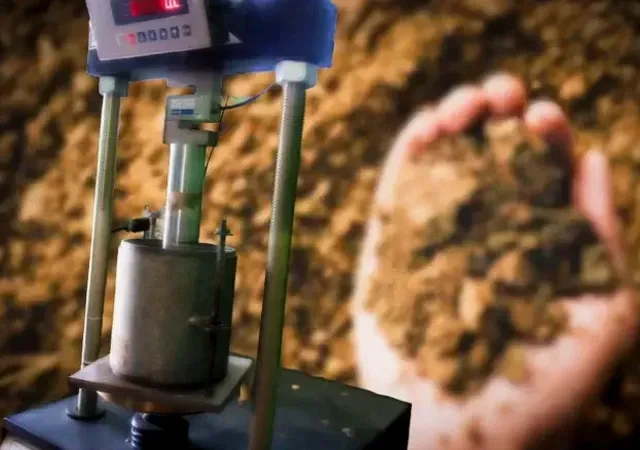
Drive from the old river terraces near Havelock North down to the Heretaunga Plains around Flaxmere and you cross several soil formations in under ten minutes. The volcanic loess on the hills can look solid in dry weather but loses strength fast when compacted wet. Down on the plains, the fine alluvial silts hold moisture differently again. That difference is exactly why a single design CBR value picked off a chart won't work here. We run the full laboratory CBR test under controlled moisture and density conditions so the pavement design actually reflects the subgrade you have, not a textbook assumption. For roading contractors working on new subdivisions around the Lyndhurst Road growth area or industrial yards near Omahu, pairing the soaked CBR with a grain-size analysis gives us the full picture: fines content, drainage potential, and the moisture sensitivity that drives rutting risk in the first wet season.
A soaked CBR value from our lab tells you what the subgrade will actually do in a Hastings winter, not what it does in summer dust.
Technical details of the service in Hastings
Demonstration video
Risks and considerations in Hastings
Hawke's Bay sits in one of the highest seismic hazard zones in New Zealand, and the 1931 magnitude 7.8 quake reshaped the very ground Hastings is built on. Liquefaction-prone silts and fine sands underlie large sections of the Heretaunga Plains, particularly south of Stortford Lodge and around the old river channels. In a seismic event, saturated subgrade loses bearing capacity and pavement structures fail at the formation level. That risk compounds when design CBR values are taken from unsoaked tests or assumed from desktop soil maps. Our laboratory CBR programme for critical routes and industrial pavements includes sensitivity analysis at multiple moisture contents so the pavement engineer can assess performance across the realistic range the subgrade will see over its design life. It is not just about rutting—it is about post-earthquake access for emergency services.
Our services
Our Hastings lab runs the full programme from sample preparation through to reporting, with turnaround times that fit construction programmes on the ground.
Soaked Laboratory CBR
Four-day soak under surcharge, swell measurement, and penetration testing at optimum and wet-of-optimum moisture. Standard for council roading submissions.
Moisture-Sensitivity CBR Series
Multiple specimens tested across a moisture range to establish the strength-moisture curve for the subgrade, used in mechanistic pavement design.
CBR with Particle Size and Plasticity
Combined package with sieve analysis and Atterberg limits, giving the full subgrade material classification per NZGS field description guidelines.
Questions and answers
What does a laboratory CBR test cost in Hastings?
Our standard soaked laboratory CBR test on a single remoulded specimen typically runs between NZ$220 and NZ$330, depending on whether we are testing at one moisture point or a series. If you need multiple compaction efforts or a full moisture-sensitivity curve with three or more specimens, the programme cost scales accordingly. We quote each job individually after reviewing the specification because the number of moulds and soak duration drive the lab time.
Do we need soaked or unsoaked CBR for a Hastings District Council roading submission?
Soaked, always. Hastings District Council follows NZTA practice and requires four-day soaked CBR values for unbound granular pavement design. Unsoaked results are useful for construction quality control on dry granular layers but will not be accepted for subgrade evaluation in a consent or engineering approval submission.
How long does the lab CBR test take from sample drop-off to report?
Count on five to six working days once the sample is in the lab. The four-day soak is the long pole in the process. We can expedite compaction and penetration on either side of the soak, but the saturation time is fixed by the standard. If you are on a tight programme, drop samples early in the week and we will have the report by Friday or the following Monday.
Can you test gravels and basecourse aggregates in the CBR mould?
Yes, within the particle size limits of the 152 mm mould. For basecourse materials with particles larger than about 20 mm, we scalp the oversize and apply the NZS 3404 correction. We will always note the scalping percentage on the report so the designer can judge whether a field CBR test on the compacted layer would be more representative.