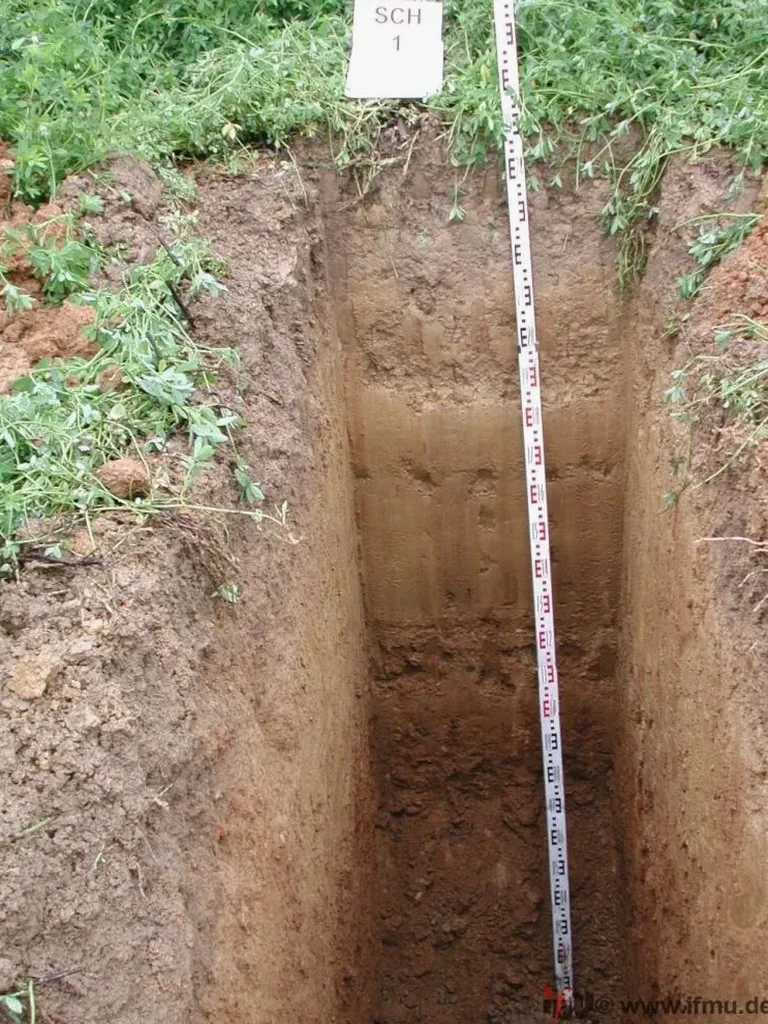
Hastings grew fast on the Heretaunga Plains, and anyone who has dug a fence post around Flaxmere or Havelock North knows the ground changes within a few hundred metres. You hit gravel lenses left by the old Ngaruroro riverbed, then silt, then pumice sands that compact under load. An exploratory test pit is still the most direct way to see what is actually down there before the excavator arrives. We open the trench, log the sequence, measure groundwater ingress, and take undisturbed samples where the layers matter most. For deeper strata or liquefaction assessment we often pair the pit work with spt-drilling to get SPT N-values below the water table, and when pavements are in play we check cbr-road on the subgrade exposed in the pit wall.
A test pit in Hastings gravels tells you more in 30 minutes of face-logging than three days of guessing from a desk study.
Technical details of the service in Hastings
Risks and considerations in Hastings
Hawke's Bay summers bake the topsoil hard, but the winter rains turn Hastings silts into a slurry that collapses pit walls without warning. That seasonal contrast forces us to schedule exploratory test pits carefully, especially on orchard conversion sites where irrigation has saturated the ground for years, leaving it with the consistency of wet brown sugar. A pit that is not properly shored or benched in those conditions becomes a hazard to the logging crew and a liability to the client. The other risk is misinterpretation: a pit dug in dry weather may show a stiff clay that softens dramatically once the water table rises in July, so we insist on recording moisture profile and taking sealed samples for laboratory atterberg-limits to confirm how the soil behaves when wet. In Hastings' seismic setting, overlooking a loose sand layer at 2 metres because the pit stopped at 1.8 is an expensive shortcut we refuse to take.
Our services
We run exploratory test pits as part of wider site investigation campaigns across the Hastings district, from greenfield subdivisions to foundation checks on existing commercial buildings. Each service below can be contracted standalone or bundled.
Exploratory test pit excavation and logging
Machine-excavated pit to target depth, logged by a senior engineering geologist against NZGS descriptors, with high-resolution face photographs and a detailed layer-by-layer borelog equivalent.
Groundwater monitoring and permeability assessment
We record inflow rate during excavation, install a standpipe if required, and can run in-situ permeability tests in the pit bottom using a falling-head method for drainage design input.
Undisturbed sampling and laboratory testing package
Block and tube samples taken from pit walls and floor, transported to an IANZ-accredited lab for triaxial, consolidation, or Atterberg limits testing, giving the structural designer real strength parameters, not textbook values.
Questions and answers
How much does an exploratory test pit cost in Hastings?
For a standard pit 2.5 to 3.5 metres deep with full face logging, sampling, and a factual report, you are generally looking at NZ$950 to NZ$1,500 per pit plus the excavator hire. The spread depends on access, shoring requirements, and whether we run extra in-situ tests like hand shear vane or permeability in the same pit.
What depth can you reach with a test pit compared to a borehole?
In Hastings gravels we typically stop between 3.5 and 4.2 metres, limited by the excavator arm reach and the bucket size. Below that, the pit becomes unsafe without extensive shoring, so we switch to SPT drilling or CPT probing to get strength data at depth.
Do you backfill the pit and compact it afterwards?
Yes, we backfill with the site-won material placed in lifts and compacted with the excavator bucket or a plate compactor depending on access. If the pit was dug through a future foundation footprint, we log the backfill procedure and can re-test density so the structural engineer knows the ground has been restored.
Can you take samples for environmental contamination testing from the pit?
We can collect soil samples for chemical analysis, but an exploratory test pit is primarily a geotechnical tool. If you need a contaminated land investigation under the NES for soil contaminants, we coordinate with a specialist environmental consultant and can split samples at the pit face.
How soon do we get the test pit report after the fieldwork is done?
A factual report with logs, photos, groundwater readings, and sample locations is typically issued within three to five working days. If laboratory testing is included, the final interpretative report follows once all lab results are back, usually within two to three weeks from site work.