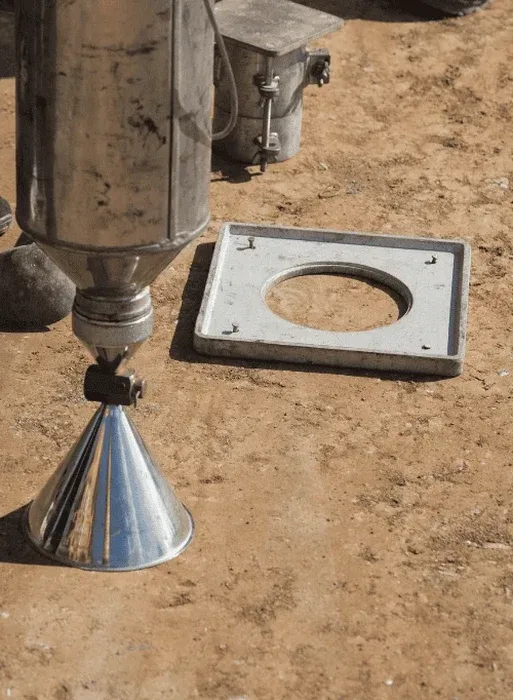
On a subdivision earthworks job out near Flaxmere, the difference between passing and failing a compaction test often comes down to how well the lab technician reads the moisture condition of the local shallow gravels. In Hastings, site supervisors know that density testing isn't just a tick-box exercise—it's the direct measure that keeps structural fill from settling unevenly under the region's loess-derived silts. Our field team runs the sand cone method strictly to NZS 4407, quantifying in-place dry density against the laboratory maximum from grain size and Proctor curves. When the Heretaunga Plains sediments show variable gravel content, we often combine density checks with CBR road testing to confirm pavement subgrade stiffness in the same visit. For deeper fill control on large commercial pads, the data pairs logically with plate load tests to correlate surface modulus with bulk density, giving project engineers a complete picture of compaction quality before structural loads are applied.
On the Heretaunga Plains, a sand cone test isn't just a number—it's the physical proof that your fill won't settle differentially after the next wet winter.
Technical details of the service in Hastings
Risks and considerations in Hastings
Hastings expanded rapidly across the Heretaunga Plains after the 1931 earthquake, with much of the post-war housing stock built on reworked alluvial silts and sands that can vary from loose to dense within a single section. The 1931 Hawke's Bay quake, magnitude 7.8, liquefied large areas of the plains—a reminder that poorly compacted fill over liquefiable layers presents a dual hazard. Undetected low-density zones beneath floor slabs or road formations in suburbs like St Leonards or Mahora can trigger differential settlement after heavy rainfall, cracking pavements and damaging services. An engineer who skips systematic field density verification during backfill placement accepts a risk that manifests slowly, but expensively. Our technicians target minimum 95% standard Proctor density on structural fill, documenting each test location with GPS coordinates tied to the site earthworks plan, so that no lift is signed off without physical evidence of compliance.
Our services
Field density verification across Hastings involves more than just the sand cone method. We provide a complete compaction QA package tailored to the soil conditions of the Heretaunga Plains:
Sand Cone Density Testing
In-place dry density and moisture content by the sand replacement method, compliant with NZS 4407 Test 4.1, with same-day reporting for earthworks sign-off.
Nuclear Gauge Correlation
Paired sand cone and nuclear densometer tests to establish site-specific calibration curves, improving testing frequency while maintaining NZS compliance on large subdivisions.
Compaction Control Plans
Development of lift thickness, roller type, and moisture conditioning specifications for controlled fill placement on Hastings gravelly silts, referencing NZGS best practice.
Trench and Service Backfill QA
Density verification for pipeline and cable trench reinstatement within road reserves, ensuring compliance with Hastings District Council engineering standards.
Questions and answers
What does a sand cone field density test cost in Hastings?
For a single field density test using the sand cone method, budget between NZ$160 and NZ$240 per test location. The final rate depends on the number of tests per day, site access conditions across the Heretaunga Plains, and whether paired nuclear gauge calibration is required. We provide firm quotes after reviewing the earthworks programme.
How long does it take to get results from a field density test?
The on-site procedure takes about 20 minutes per location. Because we determine the moisture content using a portable drying setup, we can report the dry density ratio within the same working day. Large subdivision testing rounds across Hastings are typically reported in a batch by end of day.
What compaction standard applies to structural fill in Hastings?
The Hastings District Council engineering standards generally require a minimum of 95% standard Proctor density for structural fill beneath building platforms and within 300 mm of road subgrade. We follow NZS 4407 for the test method and NZGS guidelines for the frequency and interpretation of results.
Can you test density in soils with gravel and cobbles?
The sand cone method works reliably in soils with particles up to about 40 mm. Where the fill contains larger cobbles, the test volume must be increased to compensate, and we often pair the sand cone with a larger replacement method or a calibrated plate load test to verify stiffness independently. We assess the grain size distribution on site to choose the appropriate technique.
How many density tests are required for a residential slab in Hastings?
The typical requirement is one test per lift per 100 square metres of compacted area, with a minimum of three tests per lift for a standard residential platform. We coordinate with the earthworks contractor to test each lift before the next is placed, preventing delays in the council sign-off process.