The ground under Hastings tells two very different stories. In Havelock North, the limestone-derived soils provide a firm bearing stratum that transmits high-frequency shaking directly into a structure. Move across to the low-lying plains near Flaxmere, and you are dealing with deep alluvial silts and gravels from the Ngaruroro River — soils that amplify longer-period motion and can liquefy at shallow depths. The 1931 Hawke's Bay earthquake reshaped this entire landscape, and the Heretaunga Plains basin effect is now well documented in NZGS seismic hazard studies. For engineers working across Hastings, base isolation seismic design is not a generic import; it requires tuning the isolation period to the specific spectral response of silty gravels versus weathered limestone, and that demands a seismic microzonation approach before selecting isolator properties.
A well-tuned base isolation system in Hastings shifts the fundamental period past 2.5 seconds, far from the 0.4–0.8 second range where the Heretaunga Plains basin amplifies motion the most.
Technical details of the service in Hastings
Risks and considerations in Hastings
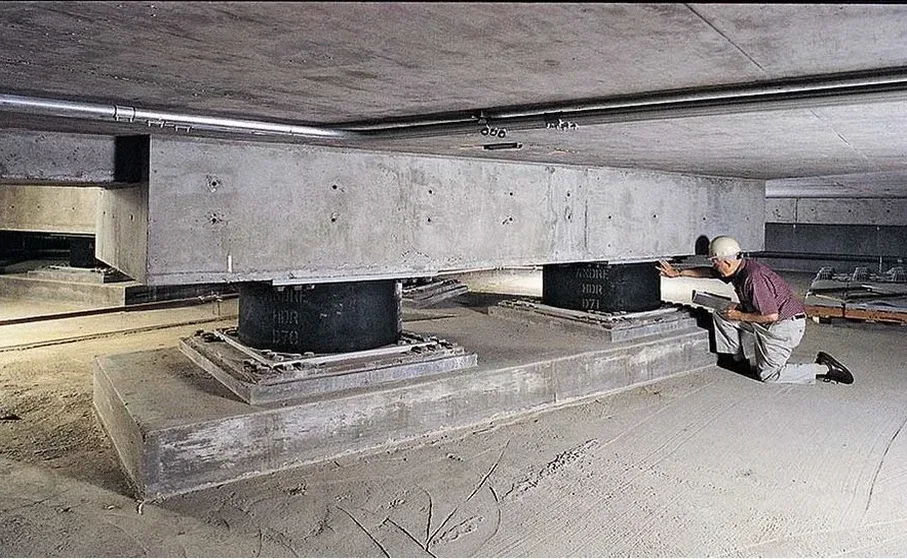
On Hastings sites, the most frequent oversight we encounter is treating base isolation as a standalone solution without addressing the soil-structure interface. The isolator can only deliver the calculated period shift if the foundation slab remains rigid and the ground beneath it does not degrade during the shaking. On the low-lying alluvial corridor between the Tukituki and Ngaruroro rivers, cyclic softening of saturated silty layers can tilt the entire isolation plane, concentrating displacement on a few corner bearings. We have seen preliminary designs where the moat wall was dimensioned for the translational displacement alone, ignoring the additional 80–120 mm of torsional movement that a basin-edge site in Hastings would realistically experience. Another risk: specifying lead-rubber bearings without accounting for the heating effect under multiple cycles of a long-duration subduction zone earthquake. The temperature rise in the lead core reduces the characteristic strength mid-event, potentially increasing displacement beyond the code limit.
Our services
Our Hastings base isolation design package covers the full workflow from site-specific hazard definition through to peer review documentation. We work directly with structural engineers and architects across Hawke's Bay to integrate the isolation system without compromising the architectural concept.
Isolator Selection and Prototype Testing Specification
Define LRB and flat slider properties, including post-elastic stiffness, yield force, and damping correction factors, mapped to the NZS 3404 design spectra for the Hastings site class.
Nonlinear Time-History Analysis
Full 3D model with isolator hysteretic behavior, using ground motion suites matched to the Heretaunga Plains basin response and the Hikurangi subduction source.
Peer Review and PS2 Documentation
Complete design features report and producer statement documentation ready for Hastings District Council consent, with independent peer review coordination.
Questions and answers
What is the typical cost range for base isolation design on a medium-sized building in Hastings?
For a typical three-to-four-storey commercial or institutional building in Hastings, the full design package — including nonlinear time-history analysis, isolator specification, and peer review documentation — falls between NZ$6,380 and NZ$14,580 depending on the number of isolator types and the complexity of the ground motion suite.
Does the Hastings District Council require peer review for base-isolated structures?
Yes. Any building using base isolation as the primary seismic load-resisting system requires independent peer review as part of the building consent process, consistent with MBIE guidance and the NZGS design recommendations.
How do you determine the isolator displacement for a site on the Heretaunga Plains?
We run site response analysis using deep shear-wave velocity profiles — typically from MASW or downhole testing — and then apply the NZS 3404 spectrum. For Plains sites, the basin amplification pushes the spectral displacement demand higher than the code default, so we use site-specific ground motion records scaled to the 2500-year event.
Can base isolation work on liquefiable ground in Hastings?
It can, but only if the foundation system is designed to remain functional during and after lateral spreading. We typically pair the isolation design with ground improvement — stone columns or rigid inclusions — and verify the post-liquefaction residual bearing capacity before finalizing the isolator parameters.