In Hastings, we regularly encounter the Heretaunga Plains sediments—layers of silts, sands, and soft clays that make conventional shallow footings a real challenge. When a site on Omahu Road or out near Flaxmere shows less than 100 kPa bearing at 2 metres depth, stone column design becomes the conversation starter, not the fallback. Our approach draws on years of regional logging: we know where the gravels of the old Ngaruroro riverbed pinch out and where the Taupo-derived pumice sands start dominating the profile. Rather than guessing at replacement ratios, we lean on CPT testing to map the compressible zones continuously, then run the column spacing against the settlement tolerances your structure actually needs. For heavier industrial sheds or multi-storey builds, we often pair the stone column grid with plate load testing on a trial column to verify modulus before production rigs move in. The goal isn't just a sign-off; it’s a ground improvement scheme that makes sense for Hawke’s Bay’s particular depositional history.
In Hastings’ soft alluvial ground, a stone column grid tuned to local pumice silts often doubles bearing capacity at half the programme of deep piling.
Technical details of the service in Hastings
Risks and considerations in Hastings
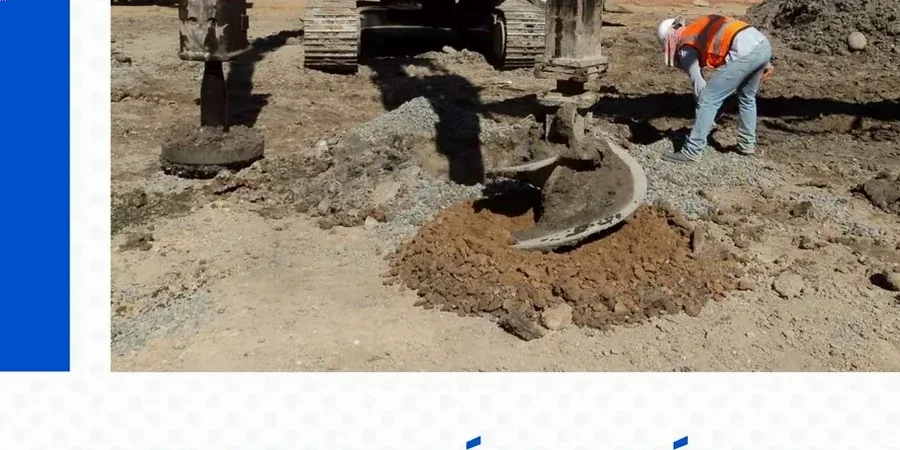
A bottom-feed vibroflot rig sitting over a Hastings site tells you a lot before the first stone goes in: if the crawler tracks start sinking into the crust before the vibro even engages, the working platform is inadequate and column installation quality will suffer from the start. The biggest risk we see isn’t the column itself—it’s lateral displacement into neighbouring boundaries when treating to depths beyond 6 metres in saturated silts, particularly on the tighter residential-zoned sections around Mayfair. Without real-time amperage logging and column-by-column recording, it’s impossible to verify that each stone column reached the design toe and achieved the target compaction energy. Post-installation, we always push for modulus verification via plate load testing on at least one production column per grid zone; skipping this leaves the structural engineer guessing about actual subgrade reaction, and in Hastings’ layered soft ground, guesswork translates directly into settlement risk.
Our services
Our stone column design process in Hastings isn’t a one-size-fits-all specification. We build the ground model first, then tailor the improvement scheme to the site’s particular layering and the structure’s loading requirements. The two core service phases below cover the full workflow from investigation to verification.
Ground investigation and column design package
We start with targeted CPT soundings and boreholes to map the soft layer thickness and groundwater level, then produce a site-specific stone column layout with spacing, diameter, depth, and gravel specification. The output includes settlement estimates and bearing capacity verification for the improved ground, all calibrated to the actual soil parameters from your site rather than regional defaults.
Installation supervision and acceptance testing
Our team monitors column installation with real-time depth and amperage logging, verifying that each column penetrates the full soft layer and achieves design compaction energy. We follow up with plate load testing on production columns to confirm modulus and bearing performance before structural works commence.
Questions and answers
What’s the typical cost for stone column design and testing in Hastings?
For a standard residential or light commercial lot in Hastings, stone column design with site investigation and verification testing typically ranges from NZ$2,400 to NZ$7,510, depending on the number of CPT soundings and plate load tests required. Larger industrial grids with multiple verification points will sit at the upper end or beyond.
How do stone columns help with liquefaction on Hastings’ silty soils?
In the Heretaunga Plains, stone columns mitigate liquefaction through three mechanisms: they densify the surrounding silty sand during vibro installation, they provide drainage paths that dissipate excess pore pressure during shaking, and they reinforce the soil mass with stiff gravel columns that carry shear even if the matrix soil temporarily loses strength. The NZGS Module 4 framework guides our design for this specific ground behaviour.
How long does a stone column installation programme take on a typical Hastings section?
For a standard 600–800 m² residential or commercial lot requiring 30–60 columns to 5–8 metre depth, the installation itself is usually two to three days with a single vibroflot rig. Add a day for pre-installation setup and working platform preparation, and another day for plate load verification testing. The whole site programme from mobilisation to demobilisation is typically under a week.